Probate Real Estate
August 17, 2026 · Marc Cormier
Selling Inherited Land in Maryland, Virginia, or DC: What Heirs Need to Know
Marc Cormier is not an attorney or CPA. This page is for general informational and entertainment purposes only and is not legal or tax advice. Every estate situation is unique. We strongly encourage you to work with qualified professionals, including a probate attorney, CPA, and experienced real estate broker, before making any decisions related to inherited property.
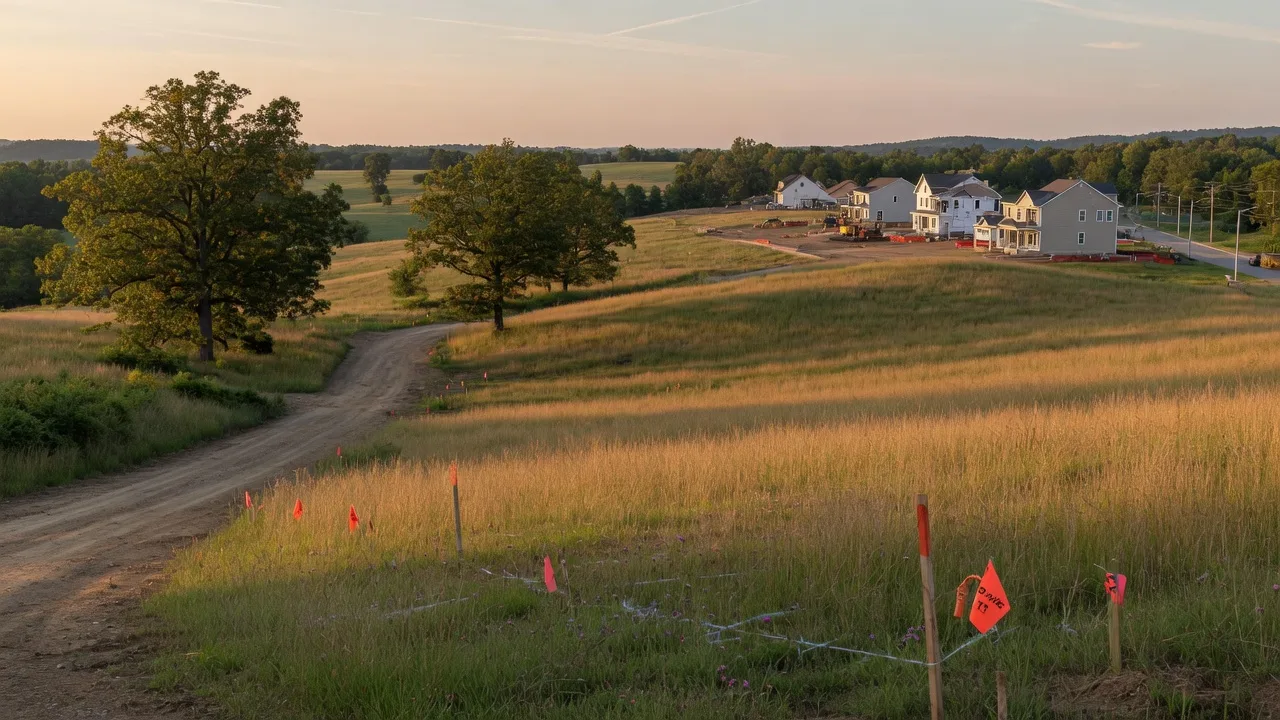
Inherited land does not behave like an inherited house. There is no kitchen to stage, no block of recent comparable sales to lean on, and often no rent check coming in while the family decides what to do. A vacant lot in Montgomery County, a farm parcel in Frederick or Carroll County, a wooded tract in Fauquier or Rappahannock, or an unimproved lot in DC all get valued and sold differently than a home, and the tax rules attached to the land itself can cost heirs real money if nobody catches them before closing.
This guide covers how inherited land is valued, what makes Maryland, Virginia, and DC different from each other on this specific issue, and where heirs lose money without realizing it.
Table of Contents
- How Is Selling Inherited Land Different From Selling an Inherited House?
- How Do You Value Inherited Land?
- What Kinds of Inherited Land Do Families in This Region Typically Deal With?
- What Should the Estate Do Before Listing Inherited Land?
- What Happens to Maryland's Agricultural Use Assessment When You Sell?
- What Happens to Virginia's Land Use Assessment When You Sell?
- What Happens to Vacant Land in DC for Tax Purposes?
- Who Buys Inherited Land in Maryland and Virginia?
- What Tax Rules Apply Beyond the Ag or Vacancy Issues?
- What Mistakes Do Heirs Make Selling Inherited Land?
- Frequently Asked Questions
- Related Reading
- Working With Someone Who Knows This Market
How Is Selling Inherited Land Different From Selling an Inherited House?
A house sells to someone who wants to live in it. Land sells to someone who wants to do something with it, and that difference changes the valuation method, the buyer pool, the financing, and the timeline.
| Factor | Inherited House | Inherited Land |
|---|---|---|
| Valuation | Comparable sales | Highest-and-best-use, income potential, development feasibility |
| Buyer pool | Homebuyers, investors | Developers, farmers, neighboring landowners, investors |
| Financing | Conventional mortgages widely available | Land loans are harder to get, higher down payments, more cash deals |
| Income while held | Can be rented | Usually none, unless leased or enrolled in a farm program |
| Due diligence | 7 to 14 days typically | Often 30 to 90+ days for survey, soil, zoning, and environmental review |
| Timeline | Weeks to months | Months to a year or more, depending on the parcel |
The biggest practical difference for most families: a house can be rented while heirs figure things out, and land usually can't. Every month you hold vacant land, property tax and any maintenance requirements come straight out of the estate's pocket with nothing coming back in, unless the parcel is leased for grazing, farming, or enrolled in a conservation program.
How Do You Value Inherited Land?
There is no single formula. An appraiser generally uses one of three approaches, and picking the right one depends entirely on what the land is.
| Approach | How It Works | Best For |
|---|---|---|
| Sales comparison | Compares the parcel to nearby land sales, adjusted for size, access, and zoning | Residential lots, smaller parcels with recent nearby sales |
| Income approach | Values the land based on what it can produce, farm income, lease income | Farmland, agricultural parcels |
| Development or residual approach | Works backward from what a developer could build and sell | Development sites, subdivisions, commercial land |
A residential appraiser who values houses all day is usually not the right person to value a 60-acre farm or a development site. Ask your broker for a referral to a land-qualified appraiser before you get a number you can't rely on.
What Kinds of Inherited Land Do Families in This Region Typically Deal With?
Residential lots and infill parcels. Vacant lots in established Montgomery, Fairfax, or Prince George's neighborhoods sell to builders or neighboring owners looking to expand. These are usually the most straightforward to value because comparable lot sales exist.
Farmland. Common across Frederick, Carroll, Washington, and Howard Counties in Maryland, and Loudoun, Fauquier, and the Shenandoah Valley in Virginia. Farmland is often enrolled in a reduced agricultural tax assessment, and selling it, or changing its use after the sale, can trigger a significant tax bill the family didn't budget for. More on this below.
Rural and wooded acreage. Western Maryland and the Virginia Piedmont both have plenty of larger wooded or recreational parcels. If the land is heavily forested, get a forester to run a timber cruise before you list. Standing timber can represent a meaningful share of the parcel's total value, and heirs who skip this step sometimes leave real money on the table without knowing it.
Vacant lots in DC. DC has relatively little raw undeveloped land, but it has plenty of vacant improved and unimproved lots, and the District taxes them very differently from an occupied property. More on that below too.
What Should the Estate Do Before Listing Inherited Land?
Confirm what you actually own. Pull the deed, verify the legal description and acreage, and order a survey. Inherited land sometimes carries boundary disputes or encroachments the prior owner never resolved.
Check zoning and legal access. Contact the local planning department to confirm zoning and permitted uses. Confirm the parcel has legal, recorded access, not just a dirt path or a driveway someone has used informally for years. A landlocked parcel without a recorded easement is much harder to sell and usually trades at a real discount.
Confirm mineral, water, and other severed rights. In some cases mineral or subsurface rights were sold or leased off decades before the current owner ever took title. A title search should reveal any recorded conveyance.
Get a date-of-death appraisal. This establishes the stepped-up basis for tax purposes, and for land, that appraiser needs experience with the specific land type. Farmland, wooded acreage, and a residential lot are three different valuation problems.
Confirm legal authority to sell. The same personal representative or trustee rules that apply to a house apply to land, and if title has already passed to multiple heirs, every co-owner generally has to sign.
What Happens to Maryland's Agricultural Use Assessment When You Sell?
Farmland enrolled in Maryland's agricultural use assessment is taxed based on its farm use value, not its full market value, which can mean a much lower annual property tax bill while the land stays in agricultural use. Sell the land, or have the buyer convert it to a non-agricultural use, and Maryland's Agricultural Transfer Tax can apply.
The tax is calculated on the sale price, generally in the range of 3 to 5 percent depending on parcel size and improvements, plus a 25 percent surcharge added on top of that base amount. A buyer who signs a Declaration of Intent to keep the land in agricultural use for five years can avoid the tax at the time of sale, but the obligation follows the property if that use changes later. Rates and thresholds get specific fast, so confirm the exact figure with the county Department of Assessments and Taxation before you price the land or negotiate who pays this at closing.
What Happens to Virginia's Land Use Assessment When You Sell?
Virginia counties that have adopted a land use ordinance, common across Loudoun, Fauquier, and much of the Shenandoah Valley, tax qualifying agricultural, horticultural, and forestal land at its use value instead of its fair market value. This is a deferral, not a permanent exemption. If the land's use changes, the county assesses a rollback tax covering the current tax year plus the five preceding years, up to six years of deferred tax difference plus interest.
If the estate is selling to a buyer who plans to develop or otherwise change the use, confirm in the purchase agreement who's responsible for the rollback tax. It can run into real money on a larger parcel, and it's the kind of number that should be disclosed and negotiated before contract signing, not discovered at settlement.
What Happens to Vacant Land in DC for Tax Purposes?
DC taxes vacant real property at a significantly higher rate than occupied residential property. As of the most recent published rates, vacant property is taxed at $5.00 per $100 of assessed value, and blighted property at $10.00 per $100, compared to roughly $0.85 per $100 for occupied Class 1 residential property. On a property assessed at $500,000, that difference is the gap between a few thousand dollars a year and tens of thousands.
If an estate inherits a vacant lot or an unoccupied property in DC, register it promptly and check whether it qualifies for a temporary exemption from the higher classification, since limited exemptions exist for properties under active construction or actively being marketed for sale. Confirm current status and any exemption eligibility with the Department of Buildings before assuming the standard vacant rate applies, since these rules have changed in recent years.
Who Buys Inherited Land in Maryland and Virginia?
Neighboring landowners are often the most motivated buyers, since they already know the parcel and may want to expand or control what happens next door. A direct letter to adjacent owners is one of the more effective outreach tactics for rural or wooded land.
Builders and developers buy based on zoning, density, and utility access, and they scrutinize every detail before making an offer.
Farmers buy agricultural land based on soil quality and productivity, and many of these deals happen off-market through local agricultural networks rather than the MLS.
Land investors and conservation buyers round out the pool, and for environmentally sensitive or scenic parcels, a conservation easement or a direct sale to a land trust is sometimes worth exploring alongside a traditional sale.
What Tax Rules Apply Beyond the Ag or Vacancy Issues?
Inherited land receives the same stepped-up basis as any other inherited property, reset to fair market value at the date of death. If the land hasn't appreciated much since then, the taxable gain on sale can be small.
A 1031 exchange is only available if the land was held for investment, not if it's held primarily for resale as inventory. If the estate subdivides the land before selling, the IRS can reclassify it as dealer property, which is taxed as ordinary income instead of capital gains and loses 1031 eligibility entirely. Talk to a CPA before subdividing anything.
What Mistakes Do Heirs Make Selling Inherited Land?
Pricing based on sentimental value instead of market value. A parcel the family has held for generations is worth what today's buyer will pay based on zoning, access, and comparable sales, not what it meant to the family.
Using a residential agent to sell rural or development land. Land requires a different valuation approach and a different buyer network than a house does.
Letting an agricultural or land use exemption lapse without understanding the tax consequence. This is the single most expensive mistake on this list, and it's entirely avoidable with a phone call to the county assessor before listing.
Not verifying legal access. A parcel without recorded access rights is worth meaningfully less, and it's much harder to finance.
Skipping environmental review. If the land had any prior industrial, agricultural chemical, or fuel storage use, a Phase I Environmental Site Assessment costs a fraction of what remediation would cost the estate later.
Frequently Asked Questions
Do you pay capital gains tax on inherited land?
Only on the gain above the stepped-up basis established at the date of death. If the land hasn't appreciated much since then, the tax exposure can be minimal.
Do you need a survey to sell inherited land?
In most cases, yes. Buyers, lenders, and title companies commonly require one, especially for rural, irregularly shaped, or previously undivided parcels.
Can one heir force the sale of inherited land in Maryland or Virginia?
If multiple heirs co-own the land directly, one co-owner can generally petition the court for a partition sale if the others won't agree, though this is usually a last resort given the cost and the way it can damage family relationships.
What if the land is landlocked?
A parcel without recorded legal access is harder to finance and sells at a discount. Your attorney can advise whether a prescriptive or negotiated easement is available.
Related Reading on Guide to Probate
- Fiduciary Duty as Personal Representative — what you're on the hook for while the estate holds real property
- Out-of-State Executors: Handling a Maryland Estate — relevant if the land sits far from where you live
- Maryland Probate FAQ — quick answers on authority to sell and inheritance tax
Working With Someone Who Knows This Market
Selling inherited land in Maryland, Virginia, or DC means dealing with tax rules that a standard home sale never touches: agricultural transfer tax, land use rollback, vacant property classification, and valuation methods that depend entirely on what the parcel can become. Missing one of these costs the estate real money, not a rounding error.
Marc Cormier is a licensed real estate professional with Berkshire Hathaway HomeServices PenFed Realty, with 27 years of probate real estate experience, serving Personal Representatives, surviving spouses, and families across Maryland, Virginia, and Washington, DC. He holds the Seniors Real Estate Specialist (SRES) designation and is the author of How To Sell Your Inherited Home.
If the estate includes land and you're not sure what tax exposure comes with selling it, schedule a consultation before you list.
Call Marc Cormier: (301) 660-6272
This article is for general informational purposes only and does not constitute legal, tax, financial, or real estate advice. Every estate situation is unique. We strongly encourage you to work with qualified professionals, including a probate attorney, CPA, and experienced real estate broker, before making any decisions related to inherited property. Marc Cormier is a licensed real estate professional, not an attorney, CPA, or financial advisor. Agricultural transfer tax, land use rollback, and vacant property tax rules change by county and by year. Confirm current rates and requirements with the relevant county office, a probate attorney, and a CPA before pricing or listing any inherited land.
About the Author
Marc Cormier is a licensed real estate professional with Berkshire Hathaway HomeServices PenFed Realty in Potomac, Maryland, with 27 years of experience and close to 1,000 homes sold. He holds the Seniors Real Estate Specialist (SRES) designation and specializes in probate, distressed property, and estate sales across Maryland, DC, and Virginia.