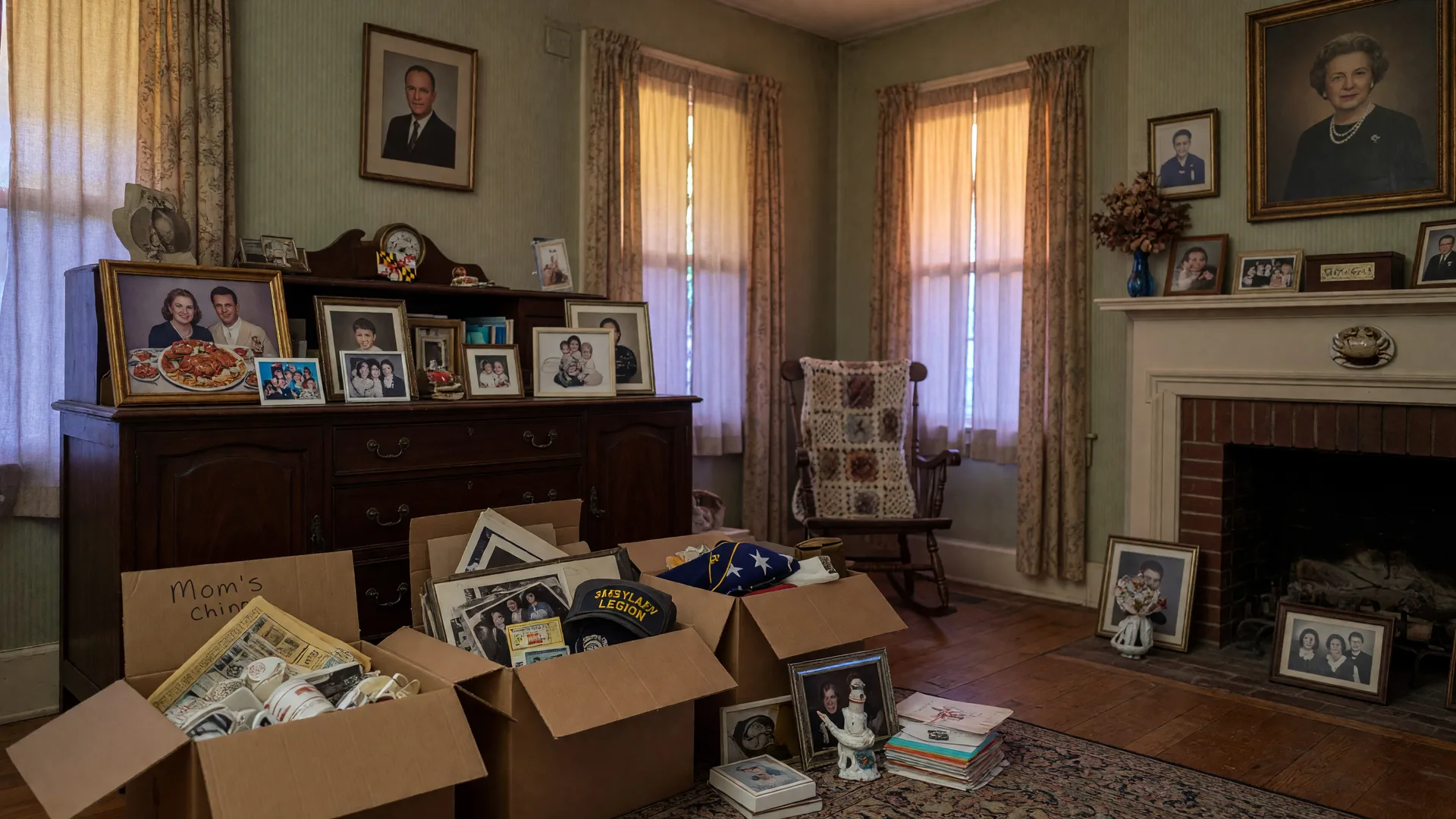
Cleaning Out a Parent's House After Death in Maryland? Don't Order the Dumpster Yet.
Before you throw away one thing, do this first.
Take pictures of every room.
Secure the jewelry, cash, documents, computers, keys and anything that might have value.
Then stop.
Because cleaning out a parent's house is not simply a junk-removal project.
In Maryland, it can be part of the probate process.
It is also part logistics.
Part real estate.
And part grief.
Do things in the wrong order and you can throw away something important, lose estate value or create a family fight that never needed to happen.
Do things in the right order and a house that feels impossible becomes a series of smaller decisions.
The goal is not to empty the house as quickly as possible.
The goal is to protect the estate, preserve what matters and create a plan for the property.
First, Understand Who Is in Charge in a Maryland Probate Estate
Maryland generally uses the term Personal Representative for the person appointed to administer a probate estate.
You may hear people use the terms executor, executrix or administrator. Maryland's Register of Wills defines these as other terms for the Personal Representative.
That distinction matters.
Being someone's child does not automatically give you authority to start distributing their probate property.
If the person owned assets in their name alone, those are generally probate assets that must be reported to the appropriate Maryland Register of Wills. A Personal Representative is appointed to administer the estate.
So before the family starts saying: "I'll take Dad's tools." "Give the furniture to charity." "Let's get a dumpster." Find out who has authority.
If you are unsure whether something belongs to the probate estate or can legally be distributed, ask the estate's Maryland probate attorney.
Maryland Regular Estate vs. Small Estate: Why It Can Matter
Maryland divides probate estates into different categories.
As of 2026, a Maryland estate generally qualifies as a small estate when probate property has a gross value of $50,000 or less. If the surviving spouse is the sole heir or legatee, the threshold increases to $100,000.
A regular estate generally applies when probate property exceeds those amounts.
Why does that matter when cleaning out a house? Because the administration and reporting requirements are different.
For example, a Maryland regular estate generally requires a formal Inventory and Account. That is one more reason not to treat the house like an ordinary cleanout.
Maryland's Three-Month Inventory Requirement
This is particularly important.
For a regular Maryland estate, the Personal Representative generally must prepare and file an Inventory within three months after appointment. The Inventory includes property owned solely by the person who died, along with certain interests in property held as tenants in common. Each item must be described and assigned its gross fair market value as of the date of death.
That means the order matters. Don't sell something for $300 and then ask: "Were we supposed to have that valued?" Figure that out first.
The Maryland Probate Cleanout Rule
Remember this order: Protect → Find → Photograph → Sort → Value → Remove → Prepare → Sell.
A dumpster belongs near the end. Not the beginning.
Step 1: Secure the Maryland Property
Your first visit should not be a cleanout. It should be a protection visit. Walk through the entire property. Check: exterior doors, windows, garage doors, spare keys, alarm systems, water leaks, heating and air conditioning, refrigerator and freezer, mail, vehicles, lawn, exterior maintenance, signs that someone else has entered.
Find out who has keys. There may be copies with: children, neighbors, caregivers, housekeepers, contractors, friends. The Personal Representative should understand who has access.
Don't Forget the Homeowners Insurance
If the house is now vacant, contact the insurance company. Don't assume the existing policy continues unchanged simply because premiums are still being paid. Tell the insurer that the owner has died and explain the occupancy status.
Also, don't automatically shut off every utility. A vacant Maryland house may still need electricity, heat, air conditioning or water to protect the property. A frozen pipe or unnoticed leak can turn a probate cleanout into a much larger problem.
Step 2: Photograph the House Before Anything Leaves
Take out your phone and document the property. Photograph: every room, closets, basement, attic, garage, workshop, storage rooms, major collections, vehicles, exterior. Take additional pictures of areas containing potentially valuable property.
This gives the Personal Representative a basic visual record of what was there before the cleanout. There is another reason to do this: once the house is emptied, it will never look exactly the same again. Those photographs may eventually mean a great deal to the family.
Step 3: Create a "DO NOT REMOVE" Room
Choose one secure bedroom, office or other area. Use it for anything that requires more review. That might include: original will, trust documents, deeds, vehicle titles, bank statements, brokerage statements, tax returns, insurance policies, pension information, business records, checkbooks, cash, jewelry, watches, coins, artwork, collections, passports, military records, computers, phones, external hard drives, keys, safe-deposit-box information, family photographs, property specifically mentioned in the will, anything that might require an appraisal.
Then make one rule: nothing leaves this room without authorization. Do this before movers, relatives or cleanout workers start carrying things outside.
What NOT to Throw Away When Cleaning Out a Parent's House in Maryland
Do not judge importance by appearance. A faded envelope may ultimately matter more than a dining-room table. Before disposing of anything, look carefully for: original wills and codicils, trust documents, life insurance policies, deeds, mortgage information, bank statements, investment statements, tax returns, vehicle titles, pension information, business records, safe-deposit information, military records, cash, jewelry and watches, coins and precious metals, family photographs, letters and handwritten notes, computers and external drives, keys, collections, anything specifically addressed by the will.
Maryland law requires the custodian of a document that appears to be the decedent's Last Will and Testament, including codicils, to file it promptly with the Register of Wills in the jurisdiction where the person was domiciled at death. So don't assume an old legal-looking document is just another piece of paper.
Search first. Clean second.
Step 4: Search the House Before the Cleanout Crew Arrives
Important things are not always where you expect them. Slow down around: desks, filing cabinets, books, envelopes, purses, briefcases, coat pockets, jewelry boxes, locked drawers, safes, toolboxes, old boxes, personal files.
You do not need to read every piece of paper. You do need to separate potentially important records from obvious trash before the large-scale cleanout begins.
Step 5: Use the Six-Category Sorting System

Do not try to make the final decision about every object while standing in the house. Create six categories.
KEEP: Items that will properly remain with or be distributed to family members.
SELL: Property valuable enough to justify selling.
APPRAISE: Anything that might have significant value but needs professional evaluation.
DONATE: Useful property that nobody wants and that the Personal Representative determines can appropriately be donated.
DISPOSE: Damaged or unusable property that can appropriately be removed.
DECIDE LATER: This category may save your family more arguments than all the others combined.
The "Decide Later" Rule
You pick up Mom's mixing bowl. It may be worth $15. But you remember making Christmas cookies with her. Your sister remembers the same thing. Now two grown adults are arguing over a $15 bowl. Stop. Put it in DECIDE LATER.
Financial value and emotional value are completely different. A $5 Christmas ornament can mean more to someone than a $5,000 piece of furniture. You do not need to settle every family memory while a cleanout truck is sitting in the driveway.
You Aren't Really Cleaning Out a House

This is the part nobody can fully prepare you for. You walk into the kitchen. Mom's coffee cup is still there. Dad's jacket is hanging by the door. You see handwriting on an old grocery list. You find the birthday card you gave them years ago. Suddenly you aren't sorting household goods anymore. You are touching pieces of someone's life.
That is why a project that looks simple on paper can become emotionally exhausting. There is a better way to deal with it.
Separate the Emotional Timeline From the Real Estate Timeline
You may not be ready to sort 25 boxes of family photographs. That's okay. Secure them. Move them to a family member's home or storage. Deal with them later. You do not necessarily need to keep a Maryland house vacant for six months because the family isn't emotionally ready to make every decision about its contents. This distinction can be important because the house may continue costing the estate money every month.
The House Has a Meter Running
A vacant Maryland property may continue generating expenses such as: mortgage payments, property taxes, homeowners insurance, utilities, HOA or condominium fees, lawn service, maintenance, repairs, security.
Imagine those expenses total $3,000 per month. The family spends six extra weeks selling small household items and makes $1,500. But the additional carrying cost is $4,500. The family worked harder and the estate ended up with less money. That is the wrong trade.
The goal is not to maximize the value of every coffee table. The goal is to protect and maximize the estate's overall result.
The One-Day Family Triage Plan
Sometimes Mom lived in Rockville but her children live in Florida, Texas and California. Everyone is only in Maryland for one weekend. Don't try to empty the entire house. Use the day to make the important decisions.
Morning — Protect: Secure the property. Photograph every room. Find estate documents. Secure valuables. Identify property specifically mentioned in the will.
Midday — Family Items: Each family member identifies sentimental items they may want. If two people want the same item: DECIDE LATER. Do not spend an hour arguing about it.
Afternoon — Separate: Create KEEP, SELL, APPRAISE, DONATE, DISPOSE, DECIDE LATER.
End of Day — Make the Property Plan: Decide what needs an appraisal, what goes into storage, whether an estate sale is worthwhile, what can be donated, what a cleanout company can remove, whether the house needs repairs, whether it should be sold as-is.
You don't need to empty the house in one day. You need to leave Maryland with a plan.
Let a Professional Carry the Load
Cleaning out a parent's home is emotionally heavy, and family and friends have their own jobs and obligations, so it can't all fall on them. In most cases we can have a property professionally cleaned out in 5-7 days, what takes families months and months of weekend afternoons to accomplish. You shouldn't have to do this alone.
Book a Free Look at the PropertyHow Maryland Families Can Reduce Arguments Over Belongings
Do not start by allowing everyone to walk around putting their name on things. Create rules first.
Rule 1: Follow the will and the Personal Representative's legal obligations.
Rule 2: Separate property that may have meaningful financial value.
Rule 3: Have each family member privately identify sentimental items they want.
Rule 4: Items wanted by only one person may be easier to resolve, subject to proper estate distribution.
Rule 5: Anything wanted by multiple people goes into DECIDE LATER.
Rule 6: Keep a simple record of significant items removed.
Rule 7: The Personal Representative controls the process.
If a disagreement becomes a question about legal ownership or distribution: Stop. That belongs with the Maryland probate attorney.
Keep the Memory Without Keeping the Entire House
A common thought is: "Mom kept this for 40 years. How can I get rid of it?" But you don't have to keep everything someone owned to remember them. Choose the objects that tell their story. Maybe that's: Dad's watch, Mom's recipe book, a handwritten letter, a Christmas ornament, a family Bible, military medals, a favorite photograph, Dad's favorite tool, Mom's Thanksgiving serving dish.
Ask: "What will I be glad I kept 20 years from now?" That is a much better question than: "Can we fit this in my basement?"
Photograph What You Don't Need to Keep
Before dismantling Dad's workshop, photograph it. Before emptying Mom's kitchen, photograph it. Before removing the dining-room furniture where the family spent Thanksgiving, take pictures. Create a digital folder: "Mom & Dad's House". Now the family can preserve the memory of the house without storing everything that was inside it.
Be Careful With Property That May Need an Appraisal
Maryland's inventory rules make valuation important. The Inventory for a regular estate generally requires fair market values as of the actual date of death. Maryland allows a Personal Representative to value certain types of property without obtaining an outside appraisal. Other property may require a qualified and disinterested appraiser.
Pay particular attention to: jewelry, watches, coins, precious metals, artwork, antiques, significant furniture, rare books, musical instruments, collections, vehicles, other potentially valuable tangible property. Don't sell first and ask about valuation later.
The Maryland House May Need a Date-of-Death Value Too
The house itself matters. Maryland's Inventory requires real property to be identified and valued as of the date of death. There can also be a federal tax reason to document value. IRS rules generally provide that inherited property's basis is its fair market value at the date of death, subject to exceptions and special rules. That can matter when inherited property is later sold. The family's CPA or tax professional should provide tax advice. But from a real estate standpoint: don't wait until after the house has been cleaned, repaired and renovated to start wondering what it was worth when Mom died.
Room-by-Room: Where Should You Start?
Office or Desk — First: Look for will, trust, tax returns, bank records, investment records, checkbooks, insurance, deeds, titles, password information, safe information. Do this before the general cleanout.
Primary Bedroom — Second: Look for jewelry, watches, cash, safes, important papers, letters, photographs, personal records. Check closets and drawers carefully.
Kitchen: Separate Sentimental (recipes, family dishes and meaningful cookware), Keep (items family members actually want), Donate (ordinary usable kitchen items), Dispose (food and damaged items). Do not turn 40 coffee mugs into 40 separate decisions.
Living and Dining Rooms: Look for artwork, antiques, collections, heirlooms, furniture that may need evaluation, photographs. Don't assume large furniture is valuable simply because it was expensive when purchased.
Basement and Attic: Slow down. These spaces can contain decades of documents, photographs, family memorabilia, holiday items, tools, collections, boxes nobody remembers. Do a family search before the cleanout crew enters.
Garage and Workshop: Separate tools, equipment, vehicles, paint, chemicals, gasoline, oil, batteries, pesticides. This leads to another Maryland-specific issue.
Maryland Disposal Rules: Don't Put Everything in the Dumpster
Cleanouts often uncover paint, pesticides, solvents, automotive fluids and other materials that should not simply be mixed with ordinary trash. The rules and programs vary by county.
Montgomery County: Montgomery County operates a Household Hazardous Waste program at the Shady Grove Processing Facility and Transfer Station in Derwood.
Howard County: Howard County provides household hazardous-waste collection for residents at its Alpha Ridge facilities.
Prince George's County: Prince George's County also provides household hazardous-waste disposal resources for residents.
For other Maryland counties, check the county's current solid-waste or environmental-services rules before the cleanout.
What If the Maryland House Is Packed Floor to Ceiling?
This requires a different approach. There may be: inaccessible rooms, thousands of papers, boxes piled high, rodent problems, mold, spoiled food, animal waste, hazardous materials, structural concerns, valuable property mixed with trash.
Do not begin by sending ten workers inside with trash bags. Start with a search pass: Documents → Valuables → Photographs → Sentimental Items → Potentially Saleable Property. Then begin the larger cleanout.
And don't judge the person who lived there. The question isn't how the property became this way. The question is: what is the safest and smartest way to solve it now?
Should You Hold an Estate Sale in Maryland?
Maybe. But a house full of belongings does not automatically mean the contents have enough resale value to justify an estate sale. Get an opinion. Ask: what do you expect the sale to gross? What is your commission? What preparation is required? How long will the process take? What happens to unsold property? Who removes the leftovers?
Then compare the likely proceeds against the delay and carrying costs of the house.
Don't Spend Three Weekends Selling $20 Items
This mistake is easy to make. Someone photographs a lamp. Lists it online. Answers messages. Negotiates. Waits for a buyer. The buyer doesn't show. Eventually the lamp sells for $25. Meanwhile, a $700,000 Maryland property is sitting vacant.
Ask: "Is selling this item worth the estate's time?" Focus on meaningful value. Don't turn the Personal Representative into a full-time garage-sale manager.
What If the Personal Representative Lives Outside Maryland?
This is common. Your mother lived in Bethesda. You live in Florida. Your sister lives in Texas. Nobody can fly into Maryland every time someone needs the front door opened. Build a local system.
1. Create a Detailed Video Walkthrough: record every room, closet, basement, garage and exterior area.
2. Identify Family Property Remotely: use photographs and video to decide what should go to family, into storage, be appraised, be sold, be donated, be removed.
3. Establish One Local Point of Contact: someone needs to coordinate access.
4. Use Local Professionals: movers, storage, appraisers, estate-sale companies, cleanout crews, contractors, cleaners, landscapers, stagers. You should not need to buy a plane ticket every time a contractor needs access to the house.
Once the House Is Empty, Don't Automatically Renovate It
This is where the cleanout becomes a real estate decision. Families often assume: "We have to fix everything before we sell." No. You need to determine which strategy is most likely to produce the best net result for the estate. There are usually three choices.
Option 1: Sell the Maryland Property As-Is
This may make sense when speed matters, the house needs substantial work, the estate doesn't want to manage contractors, belongings remain in the property, or repairs are unlikely to produce an adequate return. Advantage: fast and simple. Trade-Off: a smaller buyer pool can mean a lower price.
Option 2: Clean Out + Basic Preparation
This may include cleanout, deep cleaning, landscaping, minor repairs, removing damaged materials, improving lighting, small cosmetic improvements. For many Maryland probate homes, this can be the middle ground. You improve the buyer's first impression without turning the estate into a renovation company.
Option 3: Repair + Prepare + Stage
Sometimes more work makes financial sense. That might include painting, flooring, repairs, updated fixtures, landscaping, professional staging, professional photography. But never spend $30,000 simply because "the house will look better." First determine what that $30,000 is reasonably expected to return to the estate.
Compare NET Proceeds — Not Just the Selling Price
Imagine a Maryland probate property has two options.
Sell As-Is: Expected price $500,000. Preparation $2,000. Little additional carrying time.
Prepare for the Retail Market: Expected price $565,000. Cleanout and preparation $25,000. Additional carrying costs $5,000.
The difference isn't really $65,000. After those additional expenses, the estimated improvement is closer to $35,000, before accounting for other transaction differences. That may still make preparation an excellent decision. But now we're comparing the right numbers.
Expected Selling Price minus Preparation Costs minus Carrying Costs minus Selling Costs equals ESTIMATED NET TO THE ESTATE. That is the number that matters.
The Best Maryland Probate Cleanout Is Really a Property Plan
This is where most cleanout articles stop too soon. The goal isn't an empty house. An empty house sitting vacant for another six months hasn't solved the family's problem. The real goal is to move the property from "we don't know what to do" to "we know exactly how we're going to sell this house." The cleanout is one part of that plan.
You Don't Have to Do Everything Yourself
Being the Personal Representative does not mean you personally need to carry the sofa down three flights of stairs. Your job is to make responsible decisions for the estate.
Depending on the situation, your Maryland team may include: probate attorney, CPA, probate real estate professional, personal-property appraiser, estate-sale company, auction company, moving company, storage facility, donation organization, cleanout company, contractor, cleaner, landscaper, stager. The answer isn't hiring everyone. It's using the right people in the right order.
How We Help Maryland Families With Probate Properties
Sometimes a family calls us after the property has already been emptied. They simply need help selling the house. Other times we walk into a home containing 40 or 50 years of someone's life. The Personal Representative may live outside Maryland. The basement may be full. Repairs may be needed. The family may not know whether to renovate, sell as-is or even where to begin.
That is where we can help. We work with Maryland families to handle as much or as little of the real estate side as they need. Depending on the property, that can include: walking the property, helping develop the property strategy, coordinating movers, moving selected belongings into storage, coordinating cleanout, obtaining repair estimates, coordinating contractors, cleaning, landscaping, preparing the property, staging, photography, marketing, selling the home.
The probate attorney handles legal questions. The tax professional handles tax questions. The family decides which memories they want to keep. We help solve the house.
Before You Order a Dumpster, Get a Maryland Probate Property Plan
Get a Maryland Probate Property Plan
If you're standing in the house wondering where to start, you don't have to do it alone. We can often have a property professionally cleaned out in 5-7 days, what takes families months of weekend afternoons. Instead of spending months on weekend cleanouts, book a conversation. We will look at the property and build a plan that actually works for your family.
Book a Free Look at the PropertyFrequently Asked Questions About Cleaning Out a House During Maryland Probate
Can I clean out my parent's house before probate in Maryland?
Be careful. Securing the house and protecting important records is different from distributing, selling or throwing away estate property. If property belongs to the probate estate, determine who has authority and what must be reported or valued before disposing of it. Ask the Maryland probate attorney when you are unsure.
What is a Personal Representative in Maryland?
The Personal Representative is the person appointed to administer the estate. Maryland's Register of Wills notes that this person may also be referred to as an executor, executrix or administrator.
Does a Maryland Personal Representative have to inventory the contents of a house?
For a regular estate, the Personal Representative generally must file an Inventory within three months of appointment covering applicable probate property and its fair market value as of the date of death. Exactly what property must be included depends on ownership and the estate. Ask the estate attorney when uncertain.
Can a Personal Representative sell belongings in Maryland?
A Personal Representative administers estate property, but whether a particular item can or should be sold can depend on the will, ownership, estate obligations and Maryland probate law. When there is a question about legal authority or distribution, ask the probate attorney before selling it.
What should I look for first when cleaning out a deceased parent's house?
Start with documents and valuables. Look for wills, trusts, deeds, financial statements, tax returns, insurance policies, jewelry, cash, titles, keys, photographs, computers and anything that might require appraisal.
How should siblings divide a parent's belongings?
Follow the will and legal requirements first. For sentimental property, create a system before anyone starts claiming things. Put disputed objects aside rather than allowing one disagreement to stop the entire cleanout.
Can I donate belongings from a Maryland probate estate?
Possibly, but the Personal Representative should determine that the property can appropriately be disposed of before giving it away. Ask the estate's attorney about legal questions and the tax professional about any claimed tax consequences.
Can a Maryland probate house be sold with belongings still inside?
Sometimes. Certain buyers may purchase an as-is property with contents remaining. That can save cleanout costs and time, but it may reduce the sale price. Compare the expected net result before deciding.
Should I renovate a Maryland probate house before selling it?
Not automatically. Compare three scenarios: sell as-is, clean + basic preparation, repair + stage + retail sale. Then compare expected net proceeds, carrying costs, time and risk.
What if I live outside Maryland?
Many parts of the process can be handled remotely. Use photographs and video to identify family belongings, establish a local point of contact and use local professionals for moving, storage, cleanout, repairs and property preparation.
Before You Order a Dumpster, Get a Maryland Probate Property Plan
If you're standing inside your parent's Maryland home thinking "I don't even know where to start," start here. Protect the house. Confirm who has authority. Photograph everything. Find important documents. Secure valuables. Determine what needs to be valued. Separate sentimental property. Store what you're not ready to decide. Sell what is worth selling. Donate what makes sense. Remove the rest properly. Then decide how the house should be sold. You don't need to solve 50 years of someone's life in one weekend. And you don't have to do it alone.
Need Help With a Parent's or Loved One's House in Maryland?
Before you order a dumpster, start making repairs or spend several weekends trying to figure everything out, let's look at the property and build a plan. Sometimes selling as-is makes sense. Sometimes a cleanout and basic preparation can produce a better result. Sometimes repairs and professional staging can make a significant difference. And sometimes the biggest help is simply having someone coordinate the moving parts.
We can handle as much or as little as your family needs.
Marc Cormier
Berkshire Hathaway HomeServices PenFed Realty
Maryland: 301-660-6272
GuideToProbate.com
This article provides general Maryland real estate and probate-property information and is not legal, tax or financial advice. Probate authority, ownership and distribution questions should be directed to a qualified Maryland probate attorney. Tax questions should be directed to a qualified tax professional.
Let Us Help
Need help cleaning out an inherited Maryland home? Contact us today for a free probate consultation and discover your best options.
Book a Free Look at the Property